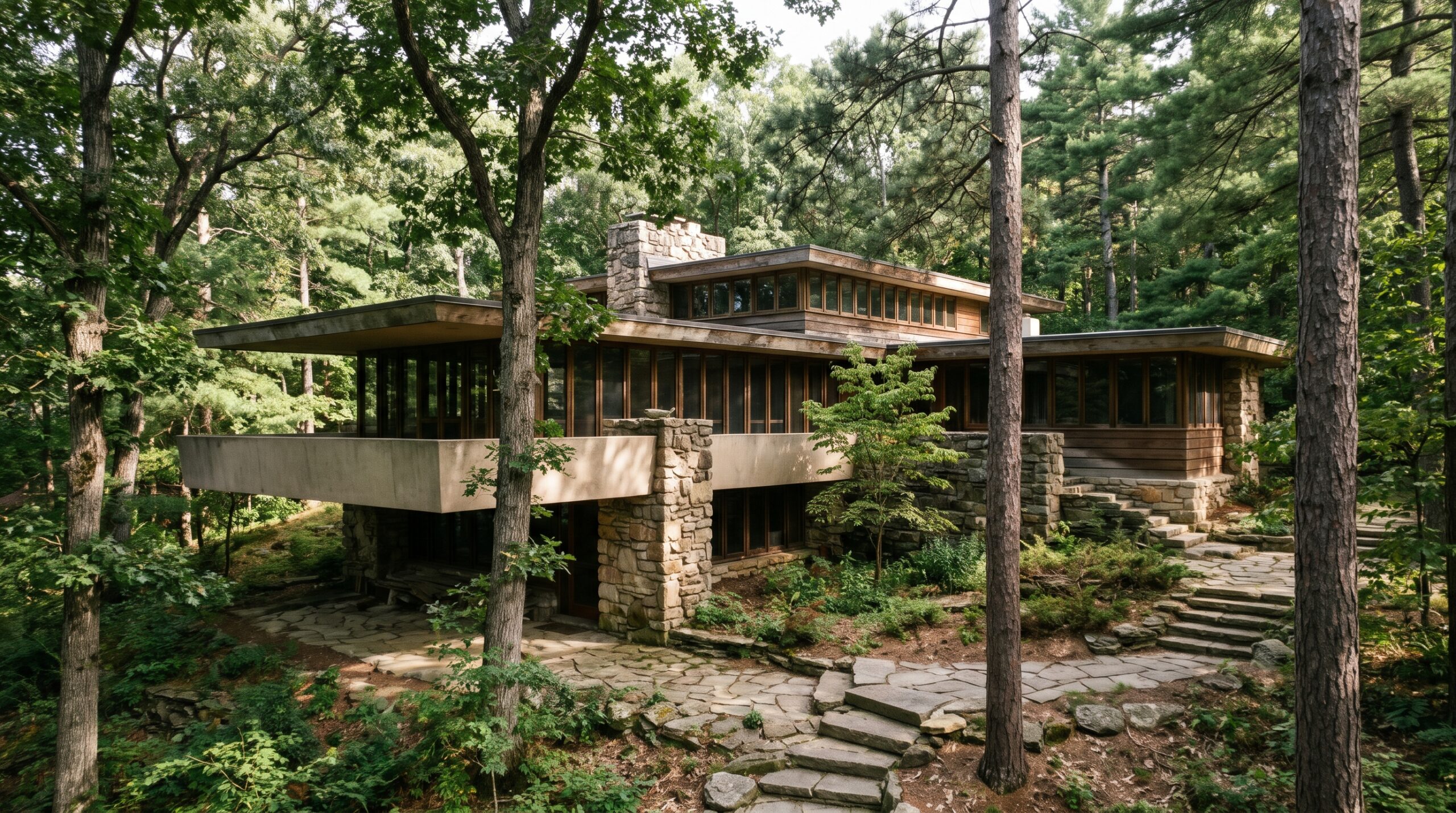
Early in his legendary career, Frank Lloyd Wright declared war on the traditional American house. He hated the typical Victorian layout—what he called the “box.” He despised how homes of that era were divided into dark, rigid, compartmentalized rooms, each locked behind its own door and serves a single, isolated function.
To Wright, those boxes were prisons for human connection. He wanted to break the box.
His solution was a philosophy he called Organic Architecture. He believed that a building should never be an artificial shape forced onto the land. Instead, it should grow naturally out of its unique site, its environment, its purpose, and the very materials it was built with. A building shouldn’t sit on a hill; it should be of the hill, flowing seamlessly with the landscape and the people who lived inside it.
Yet, if you look closely at how most nonprofits are structured today, we are still living in the Victorian boxes Wright hated.
We trap our operations inside dark, isolated silos. Development works behind one closed door, while marketing, programs, and the board sit in their own separate compartments, rarely speaking and almost never co-designing. We copy-paste generic strategic plans and operational templates from peer organizations, forcing our unique missions into artificial, cookie-cutter shapes that don’t fit our communities or our natural environment.
When you trap your mission inside rigid boxes, the work feels fragmented, your team gets exhausted, and your supporters feel the disconnect.
To build an organization capable of lasting, generational impact, we have to stop trying to force our missions into artificial templates. We need to start designing around organic architecture.
Build From the Inside Out
In theme park Imagineering, we talk about “the transition”—the unseen, organic glue that ensures different lands, stories, and experiences don’t feel like a collection of random boxes, but a single, living ecosystem.
Wright’s organic philosophy operated on that exact same principle. He believed that the exterior of a building should be a natural, honest reflection of the life happening on the inside. If the people inside needed a gathering space, that need should shape the walls—not the other way around.
Too often, nonprofits build from the outside in. We look at what is trendy in the sector, what a specific grant requires, or how another organization is structured, and we try to bend our team to fit that external shape.
Organic organizations start with their core DNA. They ask: What is the singular, natural impact we are trying to make in our community? And then they allow their teams, their workflows, and their strategies to grow outward from that purpose. When your form follows your natural function, you don’t have to waste energy trying to force collaboration—it happens because the space you’ve built demands it.
Three Ways to Apply Organic Architecture to Your Strategy
Breaking the box isn’t about throwing away structure; it is about creating a living, breathing organization where every piece feels connected to the whole. Here is how you can start redesigning your blueprint:
1. Erase the Silos and Flatten the Interior Wright pioneered the “open floor plan” because he knew that when you knock down walls, people actually talk to each other. Look at your organizational chart. Are your programs, fundraising, and communications teams operating in isolated compartments? Bring them together to co-design your year. When fundraising is involved in program design, and marketing is embedded in the field, your strategy starts to feel like a cohesive, natural ecosystem rather than a collection of separate departments.
2. Make Your Team the Workshop, Not the Spectators To truly break the box, everyone involved in your mission needs to feel like they are actively shaping it, rather than just observing it from a distance. If you want a deeply engaged community, your leadership, board, and volunteer circles cannot be treated like passive audiences. True longevity comes when you turn your supporters into active builders who help draft and construct your mission’s future from the ground up, rather than just inviting them to sit in the audience and applaud.
3. Guide Supporters on a Natural Journey In an organic blueprint, how a person experiences your mission should be carefully designed to build natural connection and emotional resonance over time. You cannot overwhelm people by throwing everything at them at once. Instead, we must choreograph our relationships, learning to pace the donor journey intentionally by creating moments of deep, focused understanding before the grand reveal of what is possible.
4. Keep Your Creative Voice Authentic Organic architecture requires us to embrace the natural materials of our work rather than covering them in a false, overly polished exterior. Donors and advocates can spot an artificial veneer from a mile away. If you want your organization’s message to truly resonate and become instantly recognizable in a crowded landscape, you have to strip away the corporate jargon and let the true, raw, and unvarnished honesty of your mission’s everyday impact shine through in everything you do.
Be of the Hill
Frank Lloyd Wright’s most famous masterpiece, Fallingwater, doesn’t just sit next to a waterfall; it is built directly over it, anchored to the natural stone, with the sound of the cascading water echoeing through every room. It is entirely of its site.
Your nonprofit should be just as deeply embedded in the natural landscape of your community.
Stop trying to fit your team, your story, and your vision into the rigid, pre-fabricated boxes of how things “should” be done. Trust your natural materials. Knock down the internal walls. Build an organization that grows organically from the ground you stand on, and you will create something that is not just functional—but truly awe-inspiring.
 Fall Savings!
Comments are closed